


 ||Message]
The concept of electromotive force is explained by means of water coller pump analogy.
In a circuit
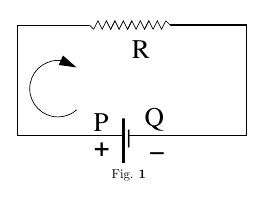
- the battery acts as a source of electromotive force,
- a potential difference is maintained between the terminals of the battery.
- the positive charges move, as expected, from electrode P at a higher, potential to the electrode \(Q\) at a lower potential.
- once the charges reach the negative terminal Q, the battery pushes them from lower to higher potential. After which the electrostatic forces take over and the charges move from \(P\) through the circuit to \(Q\).
- a current is set up in the circuit,
- the battery is constantly doing work but this energy appears as heat in the resistance.
Water Cooler, pump analogy In a water cooler
- the pump which circulates water acts like battery.
- the energy supplied to the water is lost to the environment.
- if there is no pump, gravitational forces cannot make the water circulate. Similarly the electrostatic forces inside a conductor cannot make the current flow.
In order that a current flows inside a circuit there must be nonzero work done when the charges flow in a loop. The e.m.f. \( \mathcal E\) is defined to be the work done by the electrical force in the loop . \begin{equation} \mathcal E \stackrel{\text{def}}{=}\oint \vec{E}\cdot \overrightarrow{dl} \end{equation} Now you can see why electrostatic forces alone cannot produce current in a circuit. If we place a closed circuit in any arrangement of static charges, no current will flow in the circuit because the e.m.f. in the circuit will be zero. This can be seen as follows. \begin{equation} \mathcal E = \oint \vec{E}\cdot \overrightarrow{dl} = \oint \nabla \times \vec{E}\cdot \overrightarrow{dS} =0, \end{equation} because \(\nabla\times \vec{E}\) is zero in electrostatics!
Exclude node summary :
Exclude node links:
4727:Diamond Point

