|
|
[NOTES/EM-03009]-Coulomb's Law from Maxwell's Equations --- An OutlineNode id: 5647pageThe derivation of Maxwell's first equation, \(\nabla\cdot\bar{E}=\rho/\epsilon_0\), from from Coulomb's law is outlined using the Green function for the Poisson equation.
|
|
22-08-11 12:08:38 |
n |
|
|
[NLP/QM-21001] Rayleigh Ritz Variation MethodNode id: 4822page$\newcommand{\DD}[2][]{\frac{d^2 #1}{d^2 #2}}$
$\newcommand{\matrixelement}[3]{\langle#1|#2|#3\rangle}$
$\newcommand{\PP}[2][]{\frac{\partial^2 #1}{\partial #2^2}}$
$\newcommand{\dd}[2][]{\frac{d#1}{d#2}}$
$\newcommand{\pp}[2][]{\frac{\partial #1}{\partial #2}}$
$\newcommand{\average}[2]{\langle#1|#2|#1\rangle}$
$\newcommand{\ket}[1]{\langle #1\rangle}$
qm-npl-21001
|
|
22-03-07 19:03:44 |
y |
|
|
[NOTES/ME-14015]-Moment of Inertia as Second Rank TensorNode id: 5706page$\newcommand{\DD}[2][]{\frac{d^2 #1}{d^2 #2}}$
$\newcommand{\matrixelement}[3]{\langle#1|#2|#3\rangle}$
$\newcommand{\PP}[2][]{\frac{\partial^2 #1}{\partial #2^2}}$
$\newcommand{\dd}[2][]{\frac{d#1}{d#2}}$
$\newcommand{\pp}[2][]{\frac{\partial #1}{\partial #2}}$
$\newcommand{\average}[2]{\langle#1|#2|#1\rangle}$
|
|
22-08-21 05:08:52 |
y |
|
|
[QUE/TH-12001] TH-PROBLEMNode id: 5086pageConsider a $1m^3$ cubical box at STP. Estimate the number of molecules strike one wall in one second. Take $m$, the mass of the gas to be that of Nitrogen.
|
|
22-01-13 17:01:59 |
n |
|
|
[2019CM/Final-Part-A]Node id: 5338page Classical Mechanics July 4, 2019
Instructions
| 1 |
Answers for Part-A to be written on this sheet itself. |
| 2 |
The answers for PART-B are to be written in a separate answer book. |
| 3 |
Maximum Time for Part-A is 30 mins. |
| 4 |
Attempt ALL questions from Part-A. |
- Define generalized coordinates. How many generalized coordinates are required for a bead moving on the surface of a sphere? What coordinates will you use?
- For a particle in three dimensional potential \(\lambda r^4\), write expression of effective potential and plot \(V_\text{eff}(r)\) against \(r\) for non-zero angular momentum.
- Define canonical transformation in two different ways.
|
|
22-04-03 11:04:23 |
n |
|
|
[2008EM/HMW-05]Node id: 5402page |
|
22-05-10 19:05:09 |
n |
|
|
[1998TH/LNP-04] Lecture -4 EquilibriumNode id: 5546page |
|
22-07-08 07:07:22 |
n |
|
|
Rise of Quantum MechanicsNode id: 3061curated_content |
|
19-12-28 03:12:12 |
n |
|
|
[NOTES/ME-06003]-Time Period of Oscillations--Method-1Node id: 5678page |
|
22-08-14 10:08:20 |
n |
|
|
[NOTES/QCQI-01002] Two Level System as a QubitNode id: 5019page |
|
22-04-07 13:04:27 |
n |
|
|
[QUE/TH-06003] TH-PROBLEMNode id: 5162pageShow that if
$$ \left(\frac{\partial U}{\partial V}\right)_T\,=\,0$$
then
$$ \left(\frac{\partial U}{\partial P}\right)_T\,=\,0 $$
with
$$ \left(\frac{\partial P}{\partial V}\right)_T\,\neq\,0$$
|
|
22-01-13 18:01:36 |
n |
|
|
[QUE/TH-08009] TH-PROBLEMNode id: 5220pageFor a system with two coordinates $PV$ and two other
thermodynamic coordinates $X,Y$
$$ dW = -PdW+YdX $$
a process from state 1 to state 2 at constant temperature and
constant $X$ is possible only if
\begin{eqnarray}
G_1 \le G_2\qquad&\qquad G_1\ge G_2&
\end{eqnarray}
|
|
22-01-23 18:01:52 |
n |
|
|
[NOTES/EM-02014] Flux --- Example of a point chargeNode id: 5961pageThe flux of the electric field of a point charge placed at the centre of a sphere is explicitly computed and shown to be
\[\text{Flux} = \frac{q}{\epsilon_0 }\]
|
|
23-10-18 20:10:01 |
n |
|
|
[2019EM/HMW-05]Node id: 5367pageElectrodynamics Apr 14, 2018
Tutorial-V
- A cylindrical resistor of length \(\ell\), radius \(a\) and resistivity $\varrho$ is carrying a current \(i\).
- Show that the Poynting vector $\vec{S}$ at the surface of the resistor is everywhere directed to the normal to the curved surface.
- Show the rate $\rho$ at which energy flows into the resistor through its cylindrical surface, calculated by integrating the Poynting vector over this surface, is equal to the rate at which Joule heat is produced, i.e. \begin{equation*} \int\vec{S}\cdot\vec{dA}=i^2R \end{equation*}
- A long coaxial cable consists of two concentric conductors of radii \(a,b\) and length \(\ell\), see \Figref{Cable-Self-Ind}. The inner conductor is assumed to be a thin cylindrical shell. The conductors carry currents in opposite directions. Calculate self inductance of this cable in two ways:
- Using the definition of self inductance
- Using energy considerations.
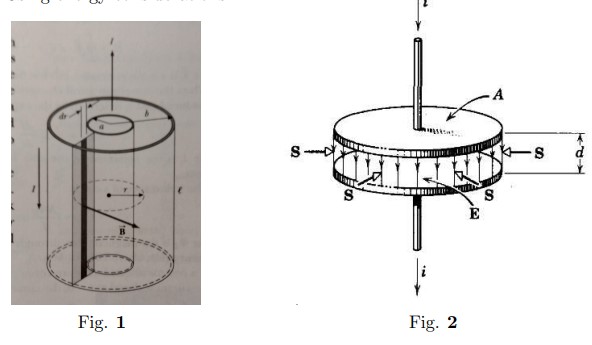
- \Figref{Capacitor} shows a parallel-plate capacitor being charged,
- Show that the Poynting vector \(S\) points everywhere radially into the cylindrical volume.
- Show that the rate \(P\) at which energy flows into this volume, calculated by integrating the Poynting vector over the cylindrical boundary of this volume, is equal to the rate at which the stored electrostatic energy increases; that is, that \[\int \vec{S}\cdot\vec{dA} = A d \frac{1}{2}\frac{d}{dt}(\epsilon \vec{E}^2)\],where \(Ad\) is the volume of the capacitor and \(\frac{1}{2} \epsilon_0\vec{E}^2\) is the energy density for all points within that volume. This analysis shows that, according to the Poynting vector point of view, the energy stored in a capacitor does not enter it through the wires but through the space around the wires and the plates. \{Hint: To find \(S\) we must first find \(B\), which is the magnetic field setup by the displacement current during the charging process; Ignore fringing of the lines of \(E\).)\}
- What happens when the current is taken to flow in the opposite direction?
- The Sun delvers about 1000 W/m\(^2\) of energy to earth's surface.
- Compute the power incident on a roof of dimension 5.0m\(\times\)8.0 m.
- Determine the radiation pressure and radiation force on the roof,assuming that the roof is a perfect absorber. \end{AlphaList1} You may assume that the Sun's rays are incident at 90\(^o\) on the roof. % Serway and Jerwett p315
|
|
22-04-25 19:04:57 |
n |
|
|
[2018EM/QUIZ-04]Node id: 5431page |
|
22-06-21 06:06:06 |
n |
|
|
[2003SM/LNP-19] Lecture 19 -- Degenerate and Non-degenerate GasesNode id: 5518page |
|
22-07-04 10:07:14 |
n |
|
|
[1998TH/LNP-13]-Node id: 5584page |
|
22-07-17 11:07:22 |
n |
|
|
Mixed-Lot of Problems in Classical Mechanics Node id: 4700collectionMixed-Lot of Problems in Quantum Mechanics
|
|
21-09-27 14:09:12 |
n |
|
|
[NOTES/EM-03011]-Summary of Maxwell's equations for ElectrostaticsNode id: 5649pageMaxwell's equations for electrostatics are summarized and relation with the known laws is described.
|
|
23-10-19 11:10:51 |
n |
|
|
[NOTES/QM-18003] Green Function for Poisson EquationNode id: 4830page$\newcommand{\DD}[2][]{\frac{d^2 #1}{d^2 #2}}$
$\newcommand{\matrixelement}[3]{\langle#1|#2|#3\rangle}$
$\newcommand{\PP}[2][]{\frac{\partial^2 #1}{\partial #2^2}}$
$\newcommand{\dd}[2][]{\frac{d#1}{d#2}}$
$\newcommand{\pp}[2][]{\frac{\partial #1}{\partial #2}}$
$\newcommand{\average}[2]{\langle#1|#2|#1\rangle}$
$\newcommand{\ket}[1]{\langle #1\rangle}$
qm-lec-18003
|
|
22-03-04 22:03:35 |
y |



 ||Message]