|
|
[YMP/EM-02010] Electric Field of Overlapping Uniformly Charged SpheresNode id: 6023page
|
Problem
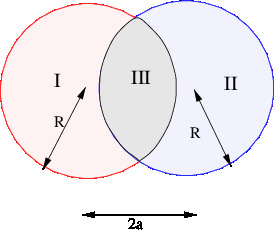
Two spheres, each of radius $R$ and carrying charge densities $+\rho$ and $-\rho$ respectively, are placed so that they partially overlap. The separation between the centers of the spheres is $D$. Show that the field in the region of overlap is constant and find its value. |
 |
|

|
23-12-04 05:12:08 |
n |
|
|
[YMP/EM-02009] Electric Field of a Uniformly Charged SphereNode id: 6022page
|
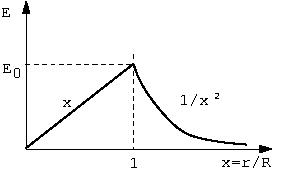
Show that the electric field of a uniformly charged sphere, radius \(R\), total charge \(Q\) has the magnitude given by\[E= \begin{cases} E_0 x & x< 1 \\ E_0/x^2 & x>1 \end{cases}\]where \(E_0= \dfrac{Q}{4\pi\epsilon_0 R^2 }\) and \(x=\dfrac{r}{R}\).
|
|
\(\newcommand{\Prime}{{^\prime}}\)
|
|
23-11-23 22:11:47 |
n |
|
|
[YMP/EM-02008] Electric Field Due to a DipoleNode id: 6013pageA dipole is a system of two equal and opposite charges separated by a distance. Its electric field is computed and the field at large distances depends only on the dipole moment, defined as the product of the charge and separation between the charges.
While dipole is a system of two charges, the concept of dipole moment is defined and is useful for any system of charges with total zero charge.
|
|
23-11-23 22:11:57 |
n |
|
|
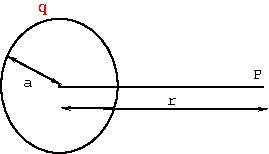
[YMP/EM-02007] Electric Field of a Uniformly Charged Spherical ShellNode id: 6020pageWe will show that for a uniformly charged sphere, radius \(a\) and charge \(Q\),
the electric field is given by
\begin{equation}
\vec E = \begin{cases} 0 & \text{if } r<a\\
\frac{Q}{4\pi\epsilon_0 R^2 } & \text{if } r > a
\end{cases}
\end{equation} |
 |
|
|
23-12-18 12:12:25 |
n |
|
|
[YMP/EM-02006] Electric Field due to a Uniformly Charged DiskNode id: 6019pageWe will show that the electric field due to a uniformly charged disk at a point on the axis of the disk is given by
|
\begin{eqnarray}
E_z &=&\frac{2Qz}{a^2 4\pi\epsilon_0}\Big[1-\frac{z}{(z^2+a^2)^{1/2}}\Big]\\ \label{eq11A}
\end{eqnarray}
At a point on the axis of the disk, only the \(z\) component is non-zero, the other two components vanish, \(E_x=E_y\).
|
 |
|
|
23-12-18 12:12:23 |
n |
|
|
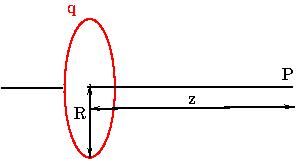
[YMP/EM-02005] Field due to a Uniformly Charged RingNode id: 6018pageThe electric field due to a charged ring, at a point, \(P\) on its axis, is computed using Coulomb's law. We will show that the electric field of uniformly charged ring, radius \(R\), at a point on the axis of the ring, is given by
\begin{equation}
\vec E = \frac{qz}{4\pi\epsilon_0(z^2+r_0^2)^{3/2}} \, \hat k.
\end{equation}
where \(q\) is the total charge and \(z\) is the distance if field point from the center of the ring. |
 |
|
|
23-12-18 11:12:07 |
n |
|
|
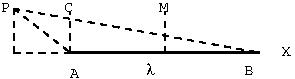
[YMP/EM-02004] Electric Field due to a Line with Uniform Charge DensityNode id: 6016pageLet \(AB\) be a line charge with charge per unit length $\lambda$, which is given to be uniform. The field is to be computed at a point \(P\),. Let \(p\) be the perpendicular distance of \(P\) from the line \(AB\). let \(\alpha, \beta\) be the angles as shown in the figure. Electric field will be calculated at a general point \(P\), the corner point \(C\) and the middle point \(M\) as shown in figure below.
|
|
23-11-23 22:11:35 |
n |
|
|
[YMP/EM-02003] Dipole Moment of Overlapping SpheresNode id: 6015page
| Two spheres each of radius $R$ are placed so that they partially overlap. The charge densities in the overlap region is zero. Outside the overlap region but inside the spheres the charge densities in the two non overlapping regions are $+\rho$ and $-\rho$, respectively, as shown in figure. The charge density in the overlap region will be zero. The separation between the centers of the spheres is $D$. |

|
- Guess the value of the dipole moment?
- Compute the dipole moment of the system and check the correctness of the expression you guessed.
- How will the dipole moment change if the two spheres equal and opposite total charges but have different radii \(a,b, a \ne b\).
|
|
23-11-23 22:11:53 |
n |
|
|
[YMP/EM-01005] Alpha Particle in Magnetic Field --- Circular OrbitNode id: 5902page |
|
23-12-12 11:12:36 |
n |
|
|
[YMP/EM-01004] Solved ProblemNode id: 5901page |
|
23-05-11 23:05:26 |
n |
|
|
[YMP/EM-01002] inkjet Printer Node id: 5900page |
|
23-05-11 23:05:45 |
n |
|
|
[YMP/EM-01001] Motion of Charged Particle in Electric FieldNode id: 5898page |
|
23-05-06 18:05:27 |
y |
|
|
[YMP/CV-05001] Elementary Functions --- Solved Examples Node id: 5621page |
|
22-08-06 19:08:02 |
n |
|
|
[YMP/CM-08003] Coriolis Force --- Focault PendulumNode id: 6308page$\newcommand{\Label}[1]{\label{#1}} \newcommand{\pp}[2][]{\frac{\partial#1}{\partial #2}}\newcommand{\PP}[2][]{\frac{\partial^2#1}{\partial #2^2}} \newcommand{\dd}[2][]{\frac{d#1}{d #2}} \newcommand{\DD}[2][]{\frac{d^2#1}{d #2^2}}$
The plane of oscillation of a simple pendulum is rotates due to Coriolis force. It is shown that the angular velocity of rotation is equal and opposite to the Earth's angular velocity. This result has the interpretation that the pendulum keeps oscillating in a fixed plane as seen from the frame fixed in stars. This is expected
|
|
24-06-19 17:06:27 |
n |
|
|
[YMP/CM-08002] How good are different frames as inertial framesNode id: 6307page |
|
24-06-19 17:06:43 |
n |
|
|
[YMP/CM-08001] Coriolis Force --- Sideways deflection of a freely falling bodyNode id: 6306page$\newcommand{\Label}[1]{\label{#1}}\newcommand{\Prime}{{^\prime}}\newcommand{\pp}[2][]{\frac{\partial#1}{\partial #2}}\newcommand{\PP}[2][]{\frac{\partial^2#1}{\partial #2^2}}\newcommand{\dd}[2][]{\frac{d#1}{d #2}}\newcommand{\DD}[2][]{\frac{d^2#1}{d #2^2}}$
A body falling under the earth's gravitational field experiences a side ways deflection due to Coriolis force. An expression for this deflection is obtained and numerical values are estimated.
|
|
24-06-19 17:06:02 |
n |
|
|
[XMP/QM-13001] Short Examples --- Nature of Energy SpectrumNode id: 6327page$\newcommand{\sech}{\rm sech}$
We give several examples to explain how to obain the nature of energy spectrum without solving the problem completely.
|
|
24-07-11 17:07:31 |
n |
|
|
[XMP/QM-06001] Short Examples --- States of a system; Id:: Node id: 1961page |
|
22-05-06 18:05:12 |
n |
|
|
[XMP/QFT-04001] Short Example --- MicrocausalityNode id: 3554page |
|
22-05-06 18:05:01 |
n |
|
|
[XMP/CM-04004] Short Examples --- Computing Hamiltonian and LagrangianNode id: 6292page$\newcommand{\pp}[2][]{\frac{\partial#1}{\partial #2}}$
|
|
24-06-11 20:06:08 |
n |



 ||Message]