|
|
Loves PythonNode id: 1607blog |

|
21-05-19 18:05:32 |
n |
|
|
Digital SignatureNode id: 1786blog |
|
19-12-28 03:12:11 |
n |
|
|
[SUNDAY-PHYSICS/CV-XTRA-05001] More Resources for Sessions 1-3Node id: 5629pageHere I have links to some additional resources for material covered in the first three sessions. (Jul 17, 24, 31, 2022)
|
|
22-08-06 19:08:51 |
n |
|
|
[NOTES/QM-16009] Solving Spherically Symmetric Problems In Quantum MechanicsNode id: 4801page$\newcommand{\DD}[2][]{\frac{d^2 #1}{d^2 #2}}$
$\newcommand{\matrixelement}[3]{\langle#1|#2|#3\rangle}$
$\newcommand{\PP}[2][]{\frac{\partial^2 #1}{\partial #2^2}}$
$\newcommand{\dd}[2][]{\frac{d#1}{d#2}}$
$\newcommand{\pp}[2][]{\frac{\partial #1}{\partial #2}}$
$\newcommand{\average}[2]{\langle#1|#2|#1\rangle}$
qm-lec-16009
|
|
22-03-07 20:03:33 |
y |
|
|
[NOTES/ME-08008]- Pseudo force vs Gravitational Force Node id: 5692page |
|
22-08-16 13:08:47 |
n |
|
|
[LECS/EM-10002]-What is Not True in Time Varying Case?Node id: 5748page |
|
22-09-03 18:09:43 |
n |
|
|
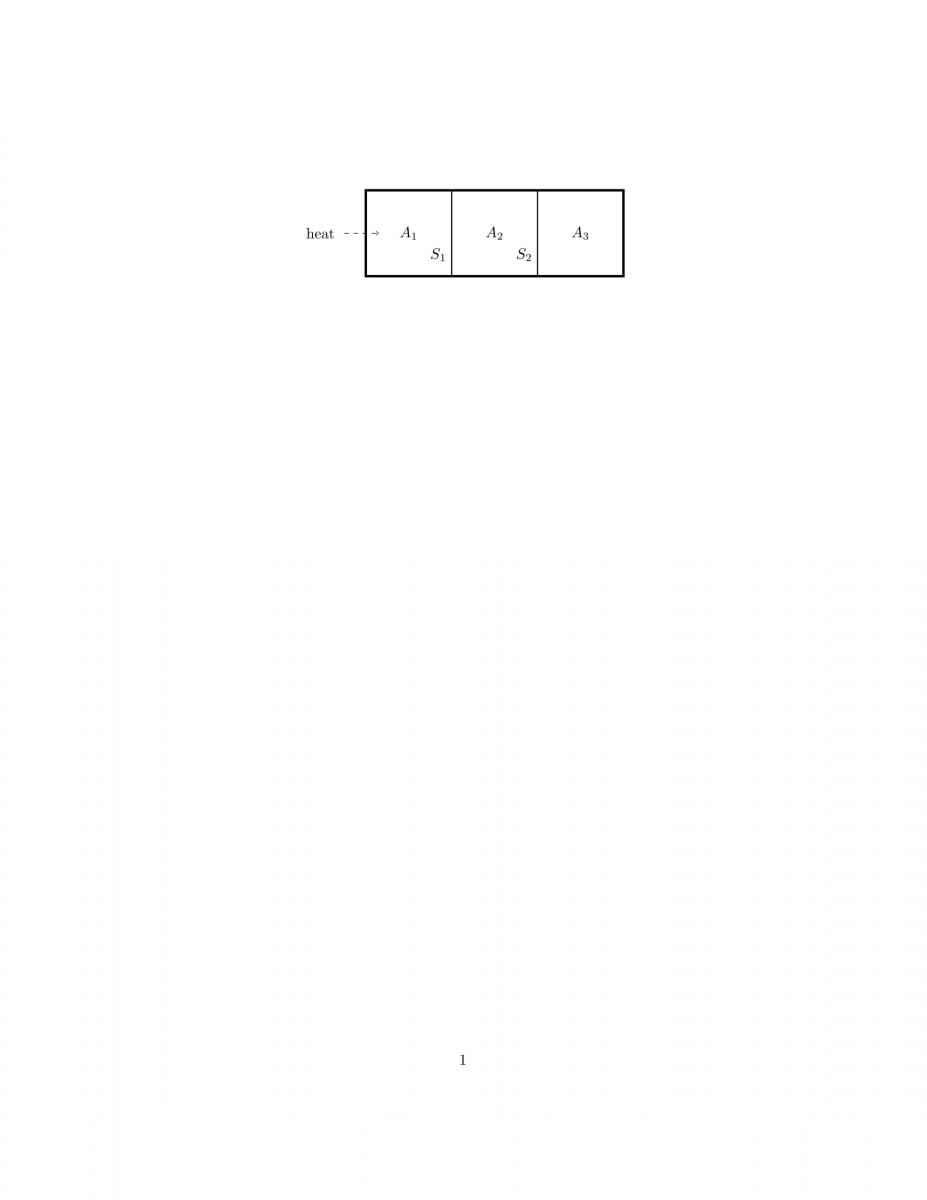
[QUE/TH-04001] TH-PROBLEMNode id: 5043pageConsider a closed cylinder whose walls are adiabatic. The cylinder is divided into three equal parts $A_1$, $A_2$ and $A_3$ by means of partitions $S_1$ and $S_2$, which can move along the length of the cylinder without friction. The partition $S_1$ is adiabatic and $S_2$ is conducting. Initially, each of the three parts contain one mole of Helium gas, which can be treated as an ideal gas, is at pressure $P_0$, temperature $T_0$ and volume $V_0$. Assume the specific heat at constant volume $C_v\,=\,\frac{3R}{2}$ and the specific heat at constant pressure $C_p\,=\,\frac{5R}{2}$. Now, heat is supplied to the to the left most partition $A_1$ till the temperature in part $A_3$ becomes $T_3\,=\,\frac{9T_0}{4}$.
(a) Find the final volume, pressure and temperature in terms of $V_0$, $P_0$ and $T_0$. Assume the entire process is quasistatic.
(b) What is work done by the gas in $A_1$ ?
(c) What is the heat supplied to the gas in $A_1$?
|
|
22-01-13 17:01:29 |
n |
|
|
[QUE/TH-03003] TH-PROBLEMNode id: 5177pageCalculate the work done when a van der Waals gas of volume $V_1$ expands to a volume $2V_1$ under (a) Constant temperature (b) Under constant pressure. The equation of the gas is
$$ \left(p\,+\,\frac{an^2}{V^2}\right)\left(V\,-\,nb\right)\,=\,nRT $$
where the symbols have the usual meanings. $a$ and $b$ are constants/
|
|
22-01-14 09:01:06 |
n |
|
|
[2013EM/HMW-08]Node id: 5382page |
|
22-04-17 10:04:03 |
n |
|
|
[2003SM/LNP-07] Lecture-07--Energy of Macroscopic Systems Classical and Quantum TheoriesNode id: 5532pageEnergy of Macroscopic Systems Classical and Quantum Theories
|
|
22-07-06 07:07:54 |
n |
|
|
[1998TH/LNP-26]-Combined the First and the Second LawNode id: 5596page |
|
22-07-17 18:07:54 |
n |
|
|
[NOTES/QM-10002] Coordinate RepresentationNode id: 4720page $\newcommand{\DD}[2][]{\frac{d^2 #1}{d^2 #2}} \newcommand{\matrixelement}[3]{\langle#1|#2|#3\rangle}\newcommand{\PP}[2][]{\frac{\partial^2 #1}{\partial #2^2}}\newcommand{\dd}[2][]{\frac{d#1}{d#2}} \newcommand{\pp}[2][]{\frac{\partial #1}{\partial #2}}$
The choice of orthonormal basis of eigenvectors of position operator gives rise to the coordinate representation. The wave function, being the expansion coefficient of state vector in this basis, gives the probability amplitude for outcomes of position measurements.In the coordinate representation the momentum operator assumes a simple form $\widehat{p} =-i\hbar \dd{x}$.
|
|
24-06-22 11:06:09 |
n |
|
|
[NOTES/ME-02005]- Finite Rotations about Arbitrary AxisNode id: 5664page |
|
22-08-17 16:08:28 |
n |
|
|
[NOTES/QM-20004] Symmetrization PostulateNode id: 4847page$\newcommand{\DD}[2][]{\frac{d^2 #1}{d^2 #2}}$
$\newcommand{\matrixelement}[3]{\langle#1|#2|#3\rangle}$
$\newcommand{\PP}[2][]{\frac{\partial^2 #1}{\partial #2^2}}$
$\newcommand{\dd}[2][]{\frac{d#1}{d#2}}$
$\newcommand{\pp}[2][]{\frac{\partial #1}{\partial #2}}$
$\newcommand{\average}[2]{\langle#1|#2|#1\rangle}$
$\newcommand{\ket}[1]{\langle #1\rangle}$
qm-lec-20004
|
|
22-03-05 08:03:09 |
y |
|
|
[LECS/EM-07003]-Magnetic Force and Torque on a ConductorNode id: 5720page |
|
22-08-23 17:08:21 |
n |
|
|
21th-hmw-02Node id: 4993page |
|
21-11-24 21:11:18 |
n |
|
|
[QUE/EM-02025] EM-PROBLEMNode id: 5128pageUse Gauss's law to find the electric field inside a uniformly charged
solid sphere of radius R and carrying charged density $\rho$. State facts
other than Gauss's law which you might have used in your answer.
|
|
22-01-09 21:01:56 |
n |
|
|
[QUE/TH-06011] TH-PROBLEMNode id: 5206page(a) Show that the work done on an ideal gas to compress it
isothermally is greater than that necessary to compress it
adiabatically if the pressure change is the same in two
processes.
(b)~Show that the isothermal work is less than the adiabatic work if
the volume change is the some in two processes
(c)~As numerical example, compare the work done from initial
pressure and volume to be 10$^6$N/m$^2$ 0.5 m$^3$ kilomole$^{-}$ in
the isothermal and adiabatic process when
(i)~the pressure is doubled (ii)~ volume is halved.
|
|
22-01-20 15:01:42 |
n |
|
|
[2019EM/QUIZ-03]Node id: 5353pageElectrodynamics Feb 19, 2019
Quiz-III
Two planes parallel to \(X-Z\) plane and two plane parallel to \(Y-Z\) plane carry uniform charge densities as shown in figure below. Find the components of the electric field in the nine regions I-IX listed below.

| |
|
|
| Region |
\(E_x\) |
\(E_y\) |
| |
|
|
| I |
|
|
| |
|
|
| II |
|
|
| |
|
|
| III |
|
|
| |
|
|
| IV |
|
|
| |
|
|
| V |
|
|
| |
|
|
| VI |
|
|
| |
|
|
| VII |
|
|
| |
|
|
| VIII |
|
|
| |
|
|
| IX |
|
|
| |

| |
|
|
| Region |
\(E_x\) |
\(E_y\) |
| |
|
|
| I |
\(\sigma/(2\epsilon_0)\) |
\(-\sigma/(2\epsilon_0)\) |
| |
|
|
| II |
\(-3\sigma/(2\epsilon_0)\) |
\(-\sigma/(2\epsilon_0)\) |
| |
|
|
| III |
\(-\sigma/(2\epsilon_0)\) |
\(-\sigma/(2\epsilon_0)\) |
| |
|
|
| IV |
\(\sigma/(2\epsilon_0)\) |
\(3\sigma/(2\epsilon_0)\) |
| |
|
|
| V |
\(-3\sigma/(2\epsilon_0)\) |
\(3\sigma/(2\epsilon_0)\) |
| |
|
|
| VI |
\(-\sigma/(2\epsilon_0)\) |
\(3\sigma/(2\epsilon_0)\) |
| |
|
|
| VII |
\(\sigma/(2\epsilon_0)\) |
\(\sigma/(2\epsilon_0)\) |
| |
|
|
| VIII |
\(-3\sigma/(2\epsilon_0)\) |
\(\sigma/(2\epsilon_0)\) |
| |
|
|
| IX |
\(-\sigma/(2\epsilon_0)\) |
\(\sigma/(2\epsilon_0)\) |
| |
|
|
22-04-03 12:04:18 |
n |
|
|
[2008EM/EVAL-Final]Node id: 5417page |
|
22-07-11 16:07:33 |
n |



 ||Message]